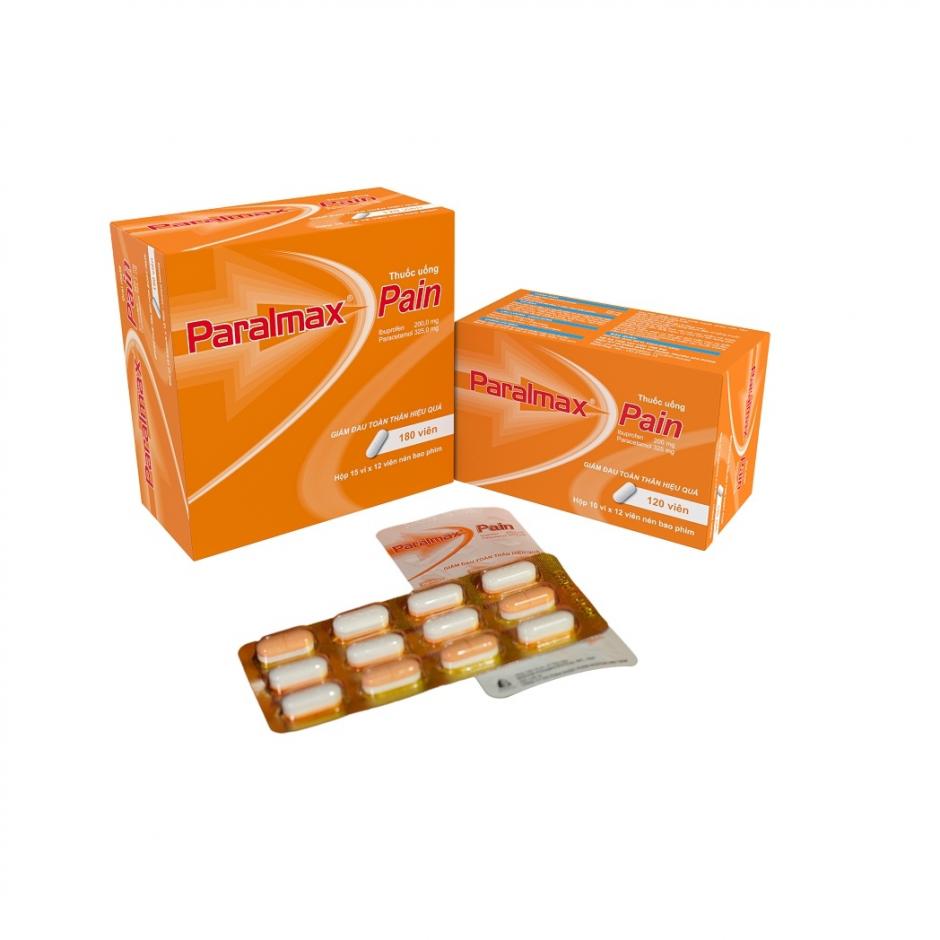
ADMINISTRATION AND DOSAGE
Dosage
Dose for adults:
Acute pain: 1 – 2 tablets x 3 times a day.
Chronic pain: 1 tablet x 3 times a day.
Administration
Oral administration.
CONTRAINDICATIONS
In patient with a known hypersensitivity to ibuprofen,
paracetamol or any other excipients in the product.
In patient with a history of hypersensitivity reaction
(e.g. bronchospasm, angioedema, asthma, urticaria)
associated with acetylsalicylic acid (aspirin) or other
NSAIDs.
In patient with active or history of recurrent peptic
ulcer/haemorrhage.
In patient with servere hepatic failure, servere renal
failure or servere heart failure.
In the last three months of pregnancy.
WARNINGS AND PRECAUTIONS
Not recommended for children under 18 years old.
Do not use concomitantly with other NSAIDs or paracetamol
containing product without doctor’s approval.
Ibuprofen can cause anaphylactoid reaction. Avoid use this
product in patients with aspirin triad (aspirin
sensitivity, asthma, nasal polyps) and use with caution in
asthma patients.
Some serious skin reaction (e.g., exfoliative dermatitis,
Stevens – Johnson syndrome, toxic epidermal necrolysis)
may occur without warning. Discontinue at first appearance
of rash or any other sign of hypersensitivity (e.g.,
blister, fever, pruritus).
Ibuprofen can increase risk of cardiovascular events
(e.g., myocardial infarction, stroke). Use with caution in
patient with cardiovascular diseases or patients with risk
factors for cardiovascular events (e.g., hypertension,
hyperlipidaemia, diabetes mellitus).
Ibuprofen is a gastrointestinal (GI) irritant. Some
serious GI toxicity (e.g., bleeding, ulceration,
perforation) can occur with or without warning symptoms.
The risk increases in those with a history of GI bleeding
or ulceration, geriatric patients, smokers, those with
alcohol dependence and those with pour general health. For
patients at high risk for complication from NSAID-induced
GI ulceration, consider concomitant use of misoprostol or
alternatively use of a proton pump inhibitor (e.g.,
omeprazole) or use of an NSAID that is a selective
inhibitor of COX-2 (e.g., celecoxib).
Long-term use of ibuprofen may cause unopposed
constriction of renal afferent arterioles, and thus
decreases the glomerular perfusion pressure and glomerular
filtration rate, which can cause fluid retention, edema or
some serious complications (e.g., renal impairment). The
risk of renal toxicity increases in patients with renal or
hepatic impairment or heart failure, in geriatric
patients, in patients with volume depletion and in those
receiving a diuretic, ACE (Angiotensin Converting Enzyme)
inhibitors or ARB (Angiotensin II Receptor Blocker). These
patients should be only treated with this product after
carefully consideration; and their renal function also
should be monitored.
Long-term use of ibuprofen and paracetamol may inhibit
platelet aggregation and prolong bleeding time.
Concomitant use with other drugs that also prolong
bleeding time should be avoided.
Avoid using alcohol during treatment with this product in
order to reduce risk of hepatic toxicity. Discontinue if
signs or symptom of liver disease or systemic
manifestations (e.g., eosinophilia, rash).
Doctor should warn the patients about the signs of
serious skin side-effects such as Stevens-Johnson syndrome
(SJS), Toxic Epidermal Necrolysic (TEN) or Lyell’
syndrome, Acute generalized exanthematous pustulosis
(AGEP).
PREGNANCY AND LACTATION
Pregnancy
Because of the risk of closure of ductus arteriosus and
bleeding in both mother and child during labour, the use
of this product should be avoid in the first six months
and contraindicated in the last three months of pregnancy.
Lactation
Ibuprofen and its metabolites can pass in very small
amount into breast milk. No harmful effects to infant are
known. Paracetamol is excreted in breast milk but non in a
clinically significant amount.
Therefore it is not necessary to interrupt breastfeeding
for short-term treatment with the recommended dose of this
product.
SHELF-LIFE
36 months from the manufacturing date. Do not use after
the expiry date.


_Paralmax_Pain.jpg)