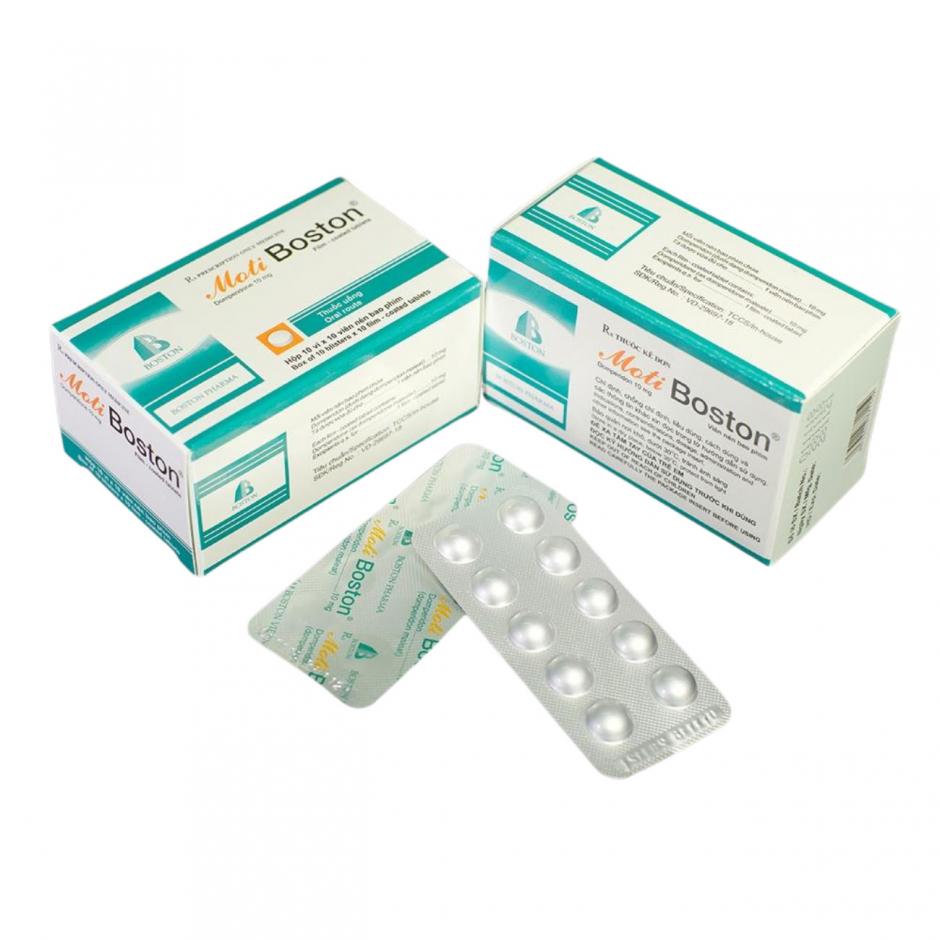
ADMINISTRATION AND DOSAGE
Posology:
Adults and adolescents (12 years of age and older and
weighing 35 kg or more)
One 10mg tablet up to three times per day with a maximum
dose of 30 mg per day.
Neonates, infants, children (less than 12 years of age)
and adolescents weighing less than 35 kg
Due to the need for accurate dosing, MOTIBOSTON are
unsuitable for use in children and adolescents weighing
less than 35 kg.
Hepatic Impairment
MOTIBOSTON is contraindicated in moderate or severe
hepatic impairment. Dose modification in mild hepatic
impairment is however not needed.
Renal Impairment
Since the elimination half-life of domperidone is
prolonged in severe renal impairment, on repeated
administration, the dosing frequency of MOTIBOSTON should
be reduced to once or twice daily depending on the
severity of the impairment, and the dose may need to be
reduced. Such patients on prolonged therapy should be
reviewed regularly.
Administration:
MOTIBOSTON should be used at the lowest effective dose for
the hortest duration necessary to control nausea and
vomiting.
It is recommended to take oral MOTIBOSTON before meals. If
taken after meals, absorption of the drug is somewhat
delayed.
Patients should try to take each dose at the scheduled
time. If a cheduled dose is missed, the missed dose
should be omitted and the usual dosing schedule resumed.
The dose should not be doubled to make up for a missed
dose.
Usually, the maximum treatment duration should not exceed
one week.
CONTRAINDICATIONS:
MOTIBOSTON is contraindicated in the following situations:
• Known hypersensitivity to domperidone or any of the
excipients
• Prolactin-releasing pituitary tumour (prolactinoma).
• when stimulation of the gastric motility could be
harmful e.g in patients with gastro-intestinal
haemorrhage, mechanical
obstruction or perforation.
• in patients with moderate or severe hepatic impairment.
• in patients who have known existing prolongation of
cardiac conduction intervals, particularly QTc, patients
with
significant electrolyte disturbances or underlying cardiac
diseases such as congestive heart failure.
• co-administration with QT-prolonging drugs, at the
exception of apomorphine.
• co-administration with potent CYP3A4 inhibitors
(regardless of their QT prolonging effects).
SPECIAL WARNINGS AND PRECAUTIONS FOR USE
Cardiovascular effects
Domperidone has been associated with prolongation of the
QT interval on the electrocardiogram. During
post-marketing surveillance, there have been very rare
cases of QT prolongation and torsades de pointes in
patients taking domperidone. These reports included
patients with confounding risk factors, electrolyte
abnormalities and concomitant treatment which may have
been contributing factors.
Epidemiological studies showed that domperidone was
associated with an increased risk of serious ventricular
arrhythmias or sudden cardiac death. A higher risk was
observed in patients older than 60 years, patients taking
daily doses greater than 30 mg, and patients concurrently
taking QT-prolonging drugs or CYP3A4 inhibitors.
Domperidone should be used at the lowest effective dose in
adults and children.
Domperidone is contraindicated in patients with known
existing prolongation of cardiac conduction intervals,
particularly QTc, in patients with significant electrolyte
disturbances (hypokalaemia, hyperkalaemia,
hypomagnesaemia), or bradycardia, or in patients with
underlying cardiac diseases such as congestive heart
failure due to increased risk of ventricular arrhythmia.
Electrolyte disturbances (hypokalaemia, hyperkalaemia,
hypomagnesaemia) or bradycardia are known to be conditions
increasing the proarrythmic risk.
Treatment with domperidone should be stopped if signs or
symptoms occur that may be associated with cardiac
arrhythmia, and the patients should consult their
physician.
Patients should be advised to promptly report any cardiac
symptoms.
Use with apomorphine
Domperidone is contra-indicated with QT prolonging
drugs including apomorphine, unless the benefit of
the coadministration with apomorphine outweighs the risks,
and only if the recommended precautions for
co-administration mentioned in the apomorphine SmPC are
strictly fulfilled. Please refer to the pomorphine SmPC.
Use in infants
Although neurological side effects are rare, the risk of
neurological side effects is higher in young children
since metabolic functions and the blood-brain barrier are
not fully developed in the first months of life.
Overdosing may cause extrapyramidal symptoms in children,
but other causes should be taken into consideration.
Renal impairment
The elimination half-life of domperidone is prolonged in
severe renal impairment. For repeated administration, the
dosing frequency of MOTIBOSTON should be reduced to once
or twice daily depending on the severity of the
impairment. The dose may also need to be educed.
Excipients
The film-coated tablets contain lactose. Patients with
rare hereditary problems of galactose intolerance, the
Lapp lactase deficiency or glucose-galactose malabsorption
should not take this medicine
SHELF-LIFE
36 months from the manufacturing date. Do not use after
the expiry date.


_motiboston_900x900.png)