

_Bosfuxim.png)
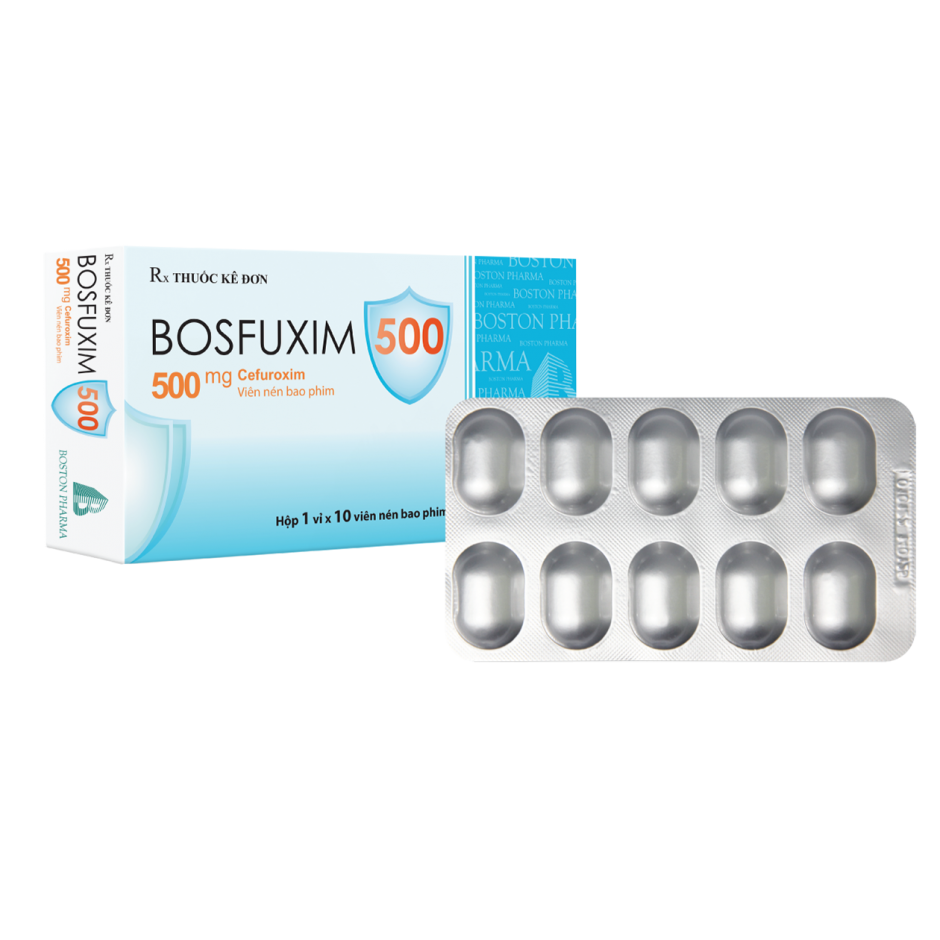
Each BOSFUXIM 500 film-coated tablet contains:
Active ingredient:
| Cefuroxim | 500 mg |
(*) Bioequivalence of Generic Drugs.
BOSFUXIM is indicated for the treatment of infections in adults and children from 3 months of age.
BOSFUXIM is indicated for the treatment of infections in adults and children from 3 months of age, including:
Consult official guidelines for appropriate use of antibiotics.
INSTRUCTIONS FOR USE:
Dosage
Adults:
|
Indication |
Dose |
|
Acute tonsillitis and pharyngitis, acute bacterial sinusitis |
250 mg twice daily |
|
Acute otitis media |
500 mg twice daily |
|
Acute exacerbations of chronic bronchitis |
500 mg twice daily |
|
Cystitis |
250 mg twice daily |
|
Pyelonephritis |
250 mg twice daily |
|
Uncomplicated skin and soft tissue infections |
250 mg twice daily |
|
Lyme disease |
500 mg twice daily for 14 days (from 10 to 21 days) |
Children (< 40 kg):
|
Indication |
Dose |
|
Acute tonsillitis and pharyngitis, acute bacterial sinusitis |
10 mg/kg twice daily up to a maximum of 125 mg twice daily |
|
Children from 2 years old with acute otitis media or more severe infections |
15 mg/kg twice daily up to a maximum of 250 mg twice daily |
|
Cystitis |
15 mg/kg twice daily up to a maximum of 250 mg twice daily |
|
Pyelonephritis |
15 mg/kg twice daily up to a maximum of 250 mg twice daily for 10–14 days |
|
Uncomplicated skin and soft tissue infections |
15 mg/kg twice daily up to a maximum of 250 mg twice daily |
|
Lyme disease |
15 mg/kg twice daily up to a maximum of 250 mg twice daily for 14 days (from 10 to 21 days) |
There is no experience with cefuroxime in children under 3 months of age.
A suspension formulation may be used for accurate dosing in children if needed.
Cefuroxime axetil tablets and cefuroxime axetil suspension are not bioequivalent and cannot be substituted on a mg basis.
Renal Impairment
The safety and efficacy of cefuroxime axetil in patients
with renal impairment have not been established.
Cefuroxime is primarily excreted via the kidneys. Dose
adjustment of cefuroxime is recommended to account for
impaired renal function. Cefuroxime is effectively removed
by dialysis.
|
Creatinine Clearance (mL/min/1.73 m²) |
Half-Life (hours) |
Recommended Dose |
|
≥ 30 mL/min/1.73 m² |
1.4 – 2.4 |
No adjustment needed (standard dose 125 mg to 500 mg twice daily) |
|
10 – 29 mL/min/1.73 m² |
4.6 |
Standard dose every 24 hours |
|
< 10 mL/min/1.73 m² |
16.8 |
Standard dose every 48 hours |
|
During Hemodialysis |
2 – 4 |
Additional standard dose after each dialysis session |
Hepatic Impairment
There is no available data in patients with hepatic
impairment. Since cefuroxime is predominantly excreted by
the kidneys, liver impairment is considered unlikely to
affect the pharmacokinetics of cefuroxime.
Administration
Administer orally. BOSFUXIM should be taken after meals
for optimal absorption.
The tablets should not be crushed, and therefore BOSFUXIM tablets are not suitable for patients who cannot swallow tablets.
CONTRAINDICATIONS
Hypersensitivity to cefuroxime or any component of the tablet.
Hypersensitivity to cephalosporin antibiotics.
History of severe hypersensitivity reactions (such as anaphylaxis) to other beta-lactam antibiotics (penicillins, monobactams, or carbapenems).
WARNINGS AND PRECAUTIONS
Hypersensitivity Reactions
Special caution is advised in patients with a history of
allergic reactions to penicillins or other beta-lactam
antibiotics due to the risk of cross-sensitivity.
Severe and sometimes fatal hypersensitivity reactions have been reported with beta-lactam antibiotics. In the event of a severe hypersensitivity reaction, discontinue cefuroxime immediately and initiate appropriate emergency measures.
Assess patient history for severe hypersensitivity to cefuroxime, other cephalosporins, or any other beta-lactam antibiotics before starting treatment. Caution is warranted in patients with a history of non-severe hypersensitivity to any beta-lactam antibiotics.
Jarisch-Herxheimer Reaction
A Jarisch-Herxheimer reaction has been observed following
cefuroxime axetil treatment for Lyme disease. This
reaction is a direct consequence of cefuroxime
axetil's antibacterial activity against Borrelia
burgdorferi, the causative agent of Lyme disease. Reassure
patients that this reaction is a common occurrence with
antibiotic treatment for Lyme disease and usually resolves
spontaneously.
Overgrowth of Non-Susceptible Microorganisms
As with other antibiotics, cefuroxime axetil may cause
overgrowth of Candida fungi. Prolonged use may lead to the
overgrowth of other non-susceptible bacteria (e.g.,
Enterococci and Clostridium difficile) and may require
discontinuation of treatment.
Antibiotic-associated pseudomembranous colitis has been
reported with most antibiotics, including cefuroxime,
ranging from mild to life-threatening. Consider this
diagnosis in patients with diarrhea during or after
cefuroxime treatment. In such cases, discontinue
cefuroxime and initiate specific treatment for Clostridium
difficile. Avoid using anti-motility agents.
Effects on Diagnostic Tests
Positive Coombs test results related to cefuroxime use may
affect cross-matching. False-negative results may occur
with ferricyanide tests; therefore, glucose oxidase and
hexokinase methods are recommended for blood glucose
determination in patients on cefuroxime axetil.
USE IN PREGNANCY AND LACTATION
Pregnancy
Data on the use of cefuroxime in pregnant women is
limited. Animal studies have not shown harm to the fetus
or adverse effects on pregnancy, embryo, or fetal
development, birth, or postnatal development. BOSFUXIM
should only be used during pregnancy if the benefit
outweighs the risk.
Lactation
Cefuroxime is excreted in breast milk in small amounts.
Although it is not believed to pose a significant risk at
therapeutic doses, the potential for diarrhea and mucosal
fungal infections in the infant cannot be excluded.
Consider discontinuing breastfeeding if necessary due to
potential adverse effects. The benefits and risks should
be evaluated by the responsible physician before use
during lactation.
Fertility
There is no available data on the effect of cefuroxime
axetil on human fertility. Animal studies do not show any
effect on fertility.
EFFECTS ON ABILITY TO DRIVE AND USE MACHINERY
No studies have been conducted on the effect of the drug
on driving or operating machinery. Since the drug may
cause dizziness, patients should be cautioned to avoid
driving or operating hazardous machinery if they
experience dizziness.
SHELF LIFE
36 months (from the date of manufacture). Do not use after
the expiry date.
STORAGE CONDITIONS
Store in a dry place below 30°C, protect from light.


Factory: No. 43, 8th Street, Vietnam - Singapore Industrial Park, Binh Hoa Ward, Ho Chi Minh City, Vietnam. Phone: (0274) 3769 606
Office:
- At Lisbon Capital (Portugal): Campo Grande nº 28, 3.º C, - lisbon, district of Lisbon, municipality of Lisbon, parish of Alvalade.
Phone: 1900 1910
- At Ha Noi City: No.38 Duc Giang Street, Viet Hung Ward, Ha Noi City, Vietnam.
Phone: (024) 7305 0606
- At Da Nang City: No.01, Ham Trung 4 Street, Hai Van Ward, Da Nang City, Vietnam.
Phone: (023) 6730 3737
- At Nha Trang City: No.29, Thai Thong Street, Nam Nha Trang Ward, Khanh Hoa Province, Vietnam.
Phone: (025) 8730 3969
- At Ho Chi Minh City: 4th Floor, Flemington Tower, 182 Le Dai Hanh, Phu Tho Ward, Ho Chi Minh City, Vietnam.
Phone: (028) 3838 0606
- At Can Tho City: No.S2-3-4-5, 10th Street, Lot 11C RIVERINE Cantho City, Hung Phu Ward, Can Tho City, Vietnam.
Phone: (029) 2730 5959
Business Registration Certificate: No. 3700843113 issued by Binh Duong Province Department of Planning and Investment on January 11, 2007
Representative: Mr. Luong Dang Khoa.


 0
0
 Check your order