DOSAGE
Adults/Elderly people
Active duodenal ulcer and active benign gastric
ulcer
The recommended dose is 1 tablet once daily. Treatment of
active duodenal ulcer time: 4 – 8 weeks and treatment of
active benign gastric ulcer time: 6 – 12 weeks.
Erosive or Ulcerative Gastro-Esophageal Reflux
Disease (GERD)
The recommended dose is 1 tablet once daily for 4 – 8
weeks.
Gastro-Esophageal Reflux Disease Long-term Management
(GERD Maintenance)
For long-term management, a maintenance dose of 1 tablet
once daily can be used.
Zollinger-Ellison Syndrome
The recommended starting dose is 3 tablets once a day.
Daily doses may up to 5 tablets in single dose or 3
tablets twice a day. Treatment should continue for as long
as clinically indicated.
Eradication of H. pylori
Rabeprazole 20 mg once daily, can be combined with
antibiotics for the eradication of H. pylori. The
selection of antibiotics should consider the individual
patient's drug tolerance and should be undertaken in
accordance with national, regional and local resistance
patterns and treatment guidelines.
Paediatric
This product is not recomended for use in children.
Renal and hepatic impairment
Dose adjustment is not needed in patients with renal or
hepatic impairment.
ADMINISTRATION
Although neither the time of day nor food intake was shown
to have any effect on rabeprazole sodium activity, it is
recommended to take Rabeboston in the morning, before
eating to facilitate treatment compliance.
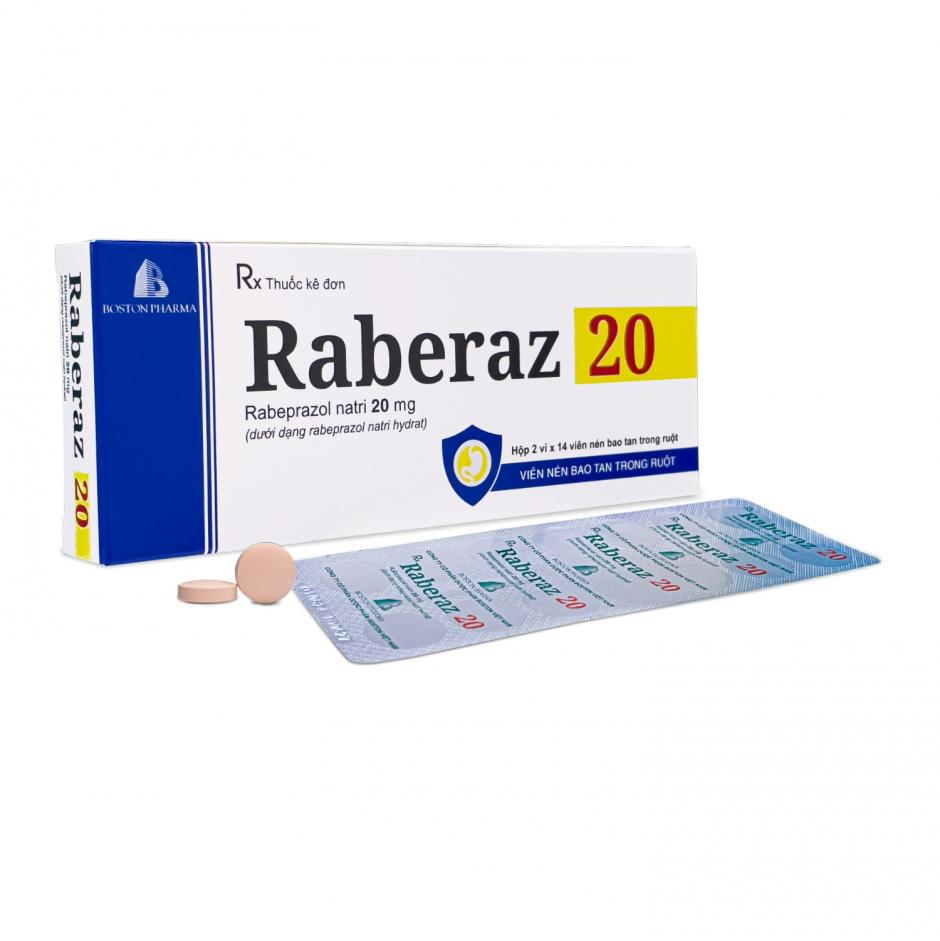
Patients should be cautioned that Rabeboston
enteric-coated tablets should not be chewed or crushed,
but should be swallowed whole.
CONTRAINDICATIONS
Hypersensitivity to rabeprazole or any excipients.
Pregnancy and breast feeding.
WARNINGS AND PRECAUTIONS
The possibility of gastric or esophageal malignancy should
be excluded prior to commencing treatment with rabeprazole
sodium because the symptomatic response to therapy with
rabeprazole sodium does not preclude the presence of this.
Proton pump inhibitors, especially if used in high doses
and over long durations (> 1 year), may modestly
increase the risk of hip, wrist and spine fracture,
predominantly in the elderly or in presence of other
recognized risk factors. Observational studies suggest
that PPIs may increase the overall risk of fracture by
10–40%. Some of this increase may be due to other risk
factors. Patients at risk of osteoporosis should receive
care according to current clinical guidelines and they
should have an adequate intake of vitamin D and calcium.
Patients on long-term treatment should be kept under
regular surveillance.
A risk of cross-hypersensitivity reactions with other PPIs
or substituted benzimidazoles can not be excluded.
There have been post marketing reports of blood dyscrasias
(thrombocytopenia and neutropenia) and hepatic enzyme
abnormalities. In the majority of cases where an
alternative aetiology can not be identified, the events
were uncomplicated and resolved on discontinuation of
rabeprazole.
There are no clinical data on the use of rabeprazole
sodium in the treatment of patients with severe hepatic
dysfunction. The prescriber is advised to exercise caution
when treatment with rabeprazole sodium is first initiated
in such patients.
Treatment with PPIs, including rabeprazole, may possibly
increase the risk of gastrointestinal infections such
as Salmonella,
Campylobacter and Clostridium difficile.
Hypomagnesaemia
Severe hypomagnesaemia has been reported in patients
treated with PPIs like rabeprazole for at least three
months, and in most cases for a year. Serious
manifestations of hypomagnesaemia such as fatigue, tetany,
delirium, convulsions, dizziness and ventricular
arrhythmia can occur but they may begin insidiously and be
overlooked. In most affected patients, hypomagnesaemia
improved after magnesium replacement and discontinuation
of the PPI.
For patients expected to be on prolonged treatment or who
take PPIs with digoxin or drugs that may cause
hypomagnesaemia (e.g., diuretics), health care
professionals should consider measuring magnesium levels
before starting PPI treatment and periodically during
treatment.
Concomitant use of rabeprazole with
methotrexate
Literature suggests that concomitant use of PPIs with
methotrexate (primarily at high dose) may elevate and
prolong serum levels of methotrexate and/or its
metabolite, possibly leading to methotrexate toxicities.
In highdose methotrexate administration, a temporary
withdrawal of the PPI may be considered in some patients.
Influence on vitamin B12 absorption
Rabeprazole sodium, as all acidblocking medicines, may
reduce the absorption of vitamin B12 (cyanocobalamin) due
to hypo- or a- chlorhydria. This should be considered in
patients with reduced body stores or risk factors for
reduced vitamin B12 absorption on longterm therapy or if
respective clinical symptoms are observed.
Subacute cutaneous lupus erythematosus (SCLE)
Proton pump inhibitors are associated with very infrequent
cases of SCLE. If lesions occur, especially in sun-exposed
areas of the skin, and if accompanied by arthralgia, the
patient should seek medical help promptly and the health
care professional should consider stopping rabeprazole
sodium. SCLE after previous treatment with a PPI may
increase the risk of SCLE with other PPIs.
INTERACTIONS
Active substances with pH dependent absorption
Rabeprazole sodium produces a profound and long lasting
inhibition of gastric acid secretion. An interaction with
compounds whose absorption is pH dependent may
occur.
Ketoconazole, itraconazole
Co-administration of rabeprazole sodium with ketoconazole
or itraconazole may result in a significant decrease in
antifungal plasma levels. Therefore individual patients
may need to be monitored to determine if a dosage
adjustment is necessary.
Atazanavir, ritonavir
Co-administration of atazanavir 300 mg/ritonavir 100mg
with omeprazole (40 mg once daily) or atazanavir 400 mg
with lansoprazole (60 mg once daily) resulted in a
substantial reduction in atazanavir exposure. Although not
studied, similar results are expected with other PPIs.
Therefore PPIs, including rabeprazole, should not be
co-administered with atazanavir or ritonavir.
Methotrexate
Concomitant use of PPIs and methotrexate (primarily at
high dose) may elevate and prolong serum levels of
methotrexate and/or its metabolite hydroxymethotrexate.
However, no formal drug interaction studies of
methotrexate with PPIs have been conducted.
PREGNANCY AND LACTATION
Pregnancy
There are no data on the safety of rabeprazole in human
pregnancy. Reproduction studies performed in rats and
rabbits have revealed no evidence of impaired fertility or
harm to the foetus due to rabeprazole sodium, although low
foeto-placental transfer occurs in rats. Rabeboston is
contraindicated during pregnancy.
Lactation
It is unknown whether rabeprazole sodium is excreted in
human breast milk. No studies in breast-feeding women have
been performed. Rabeprazole sodium is however excreted in
rat mammary secretions. Therefore Rabeboston should not be
used during breast-feeding.
EFFECTS ON ABILITY TO DRIVE AND USE MACHINES
Based on the pharmacodynamic properties and the adverse
events profile, it is unlikely that rabeprazole sodium
would cause an impairment of driving performance or
compromise the ability to use machinery. If however,
alertness is impaired due to somnolence, it is recommended
that driving and operating complex machinery be avoided.
UNDESIRABLE EFFECTS
The most commonly reported adverse drug reactions, during
controlled clinical trials with rabeprazole were headache,
diarrhea, abdominal pain, asthenia, flatulence, rash and
dry mouth. The majority of adverse events experienced
during clinical studies were mild or moderate in severity,
and transient in nature.
The following adverse events have been reported from
clinical trial and post-marketed experience.
Frequencies are defined as: common (> 1/100 to <
1/10), uncommon (> 1/1,000 to < 1/100), rare (>
1/10,000 to < 1/1000) and very rare (< 1/10,000);
not known (cannot be estimated from the available data).
|
System Organ Class
|
Undersirable effects
|
|
Infections and infestations
|
Common: Infection.
|
|
Blood and lymphatic system disorders
|
Rare: Neutropenia, leucopenia, thrombocytopenia,
leucocytosis.
|
|
Immune system disorders
|
Rare: Hypersensitivity (swelling, hypotension,
dyspnoea).
|
|
Metabolism and nutrition disorders
|
Rare: Anorexia.
|
|
Not known: Hyponatremia, Hypomagnesaemia.
|
|
Psychiatric disorders
|
Common: Insomnia.
|
|
Uncommon: Nervousness.
|
|
Rare: Depression.
|
|
Not known: Confusion.
|
|
Nervous system disorders
|
Common: Headache, dizziness.
|
|
Uncommon: Somnolence.
|
|
Eye disorders
|
Rare: Visual disturbance.
|
|
Vascular disorders
|
Not known: Peripheral edema.
|
|
Respiratory, thoracic and mediastinal disorders
|
Common: Cough, pharyngitis, rhinitis.
|
|
Uncommon: Bronchitis, sinusitis.
|
|
Gastrointestinal disorders
|
Common: Abdominal pain, constipation, diarrhea,
flatulence, nausea, vomiting.
|
|
Uncommon: Dry mouth, dyspepsia, eructation.
|
|
Rare:Gastritis, stomatitis, taste disturbance.
|
|
Hepatobiliary disorders
|
Rare: Hepatitis, jaundice, hepatic encephalopathy.
|
|
Skin and subcutaneous tissue disorders
|
Uncommon: Rash, erythema.
|
|
Rare: Pruritus, sweating, bullous reactions.
|
|
Very rare: Erythema multiform, Stevens-Johnson
syndrome (SJS), toxic epidermal necrolysis (TEN).
|
|
Not known: Subacute cutaneous lupus erythematosus.
|
|
Musculoskeletal and connective tissue disorders
|
Common: Non-specific pain, back pain.
|
|
Uncommon: Arthralgia, myalgia, leg cramps,
fracture of the hip, wrist or spine.
|
|
Renal and urinary disorders
|
Uncommon: Urinary tract infection.
|
|
Rare: Interstitial nephritis.
|
|
Reproductive system and breast disorders
|
Not known: Gynaecomastia.
|
|
General disorders and administration site
conditions
|
Common: Asthenia, influenza like illness.
|
|
Uncommon: Chest pain, chills, pyrexia.
|
|
Investigations
|
Uncommon: Increased hepatic enzymes.
|
|
Rare: Weight increased.
|
OVERDOSE AND TREATMENT
Experience to date with deliberate or accidental overdose
is limited. The maximum established exposure has not
exceeded 60 mg twice daily, or 160 mg once daily. Effects
are generally minimal, representative of the known adverse
event profile and reversible without further medical
intervention. No specific antidote is known. Rabeprazole
sodium is extensively protein bound and is, therefore, not
dialyzable. As in any case of overdose, treatment should
be symptomatic and general supportive measures should be
utilized.
STORAGE CONDITION
In a dry place, below 30°C, protect from light.
SHELF-LIFE
36 months from the manufacturing date. Do not use after
the expiry date.


_rabeboston_900x900.jpg)